〈軍爭〉第 4 課
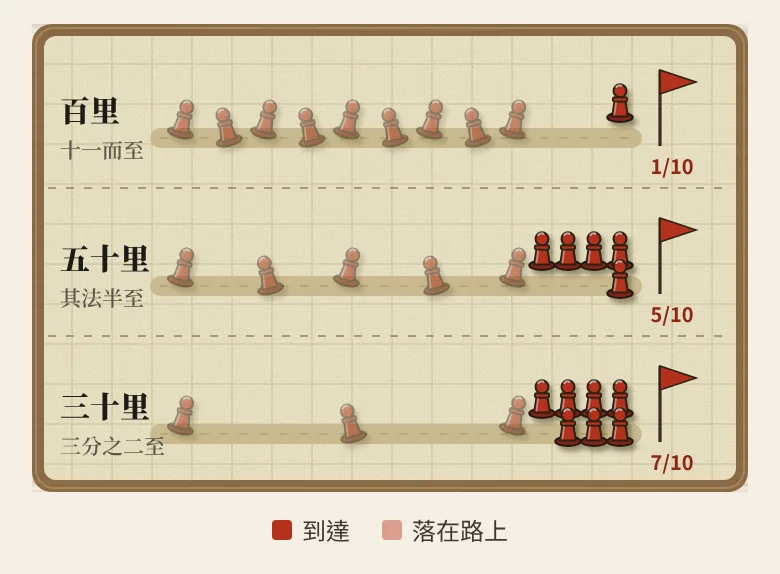
急行軍會讓團隊散掉,跑得越遠,到的人越少。
原是故卷甲而趨,日夜不處,倍道兼行,百里而爭利,則擒三軍將,勁者先,疲者後,其法十一而至;五十里而爭利,則蹶上軍將,其法半至;三十里而爭利,則三分之二至。〈軍爭〉
原意
捲起盔甲日夜急行,跑一百里去爭利,強壯的先到、疲憊的落後,只有十分之一能到,三軍將領都會被擒;跑五十里,前軍主將受挫,只有一半能到;跑三十里,只有三分之二能到。
延伸:用在今天
衝刺太猛,團隊會累垮,人才會流失。
案例 · 強弩之末:諸葛亮引兵法看曹軍
曹操追擊劉備,輕騎一日一夜跑了三百多里。諸葛亮在說服孫權聯合抗曹時指出,曹軍遠來疲憊,正是「強弩之末,勢不能穿魯縞」,並引兵法「必蹶上將軍」說明急行爭利的危險。不久曹軍在赤壁大敗。
史書有載 · 出自《三國志·蜀書·諸葛亮傳》
In English
Forced marches scatter the team; the farther you rush, the fewer arrive.
Roll up your armor and march day and night for a hundred li to seize an advantage, and the strong arrive first while the tired fall behind; only one in ten arrives and all three commanders are captured. Over fifty li the vanguard's general is defeated and only half arrive; over thirty li, two-thirds arrive.
Applied today: Sprint too hard and the team burns out and good people leave.
Original translation (Lionel Giles, 1910): Thus, if you order your men to roll up their buff-coats, and make forced marches without halting day or night, covering double the usual distance at a stretch, doing a hundred li in order to wrest an advantage, the leaders of all your three divisions will fall into the hands of the enemy. The stronger men will be in front, the jaded ones will fall behind, and on this plan only one-tenth of your army will reach its destination. If you march fifty li in order to outmanoeuvre the enemy, you will lose the leader of your first division, and only half your force will reach the goal. If you march thirty li with the same object, two-thirds of your army will arrive.