〈始計〉第 3 課
用七個問題比較雙方,就能預判勝負。
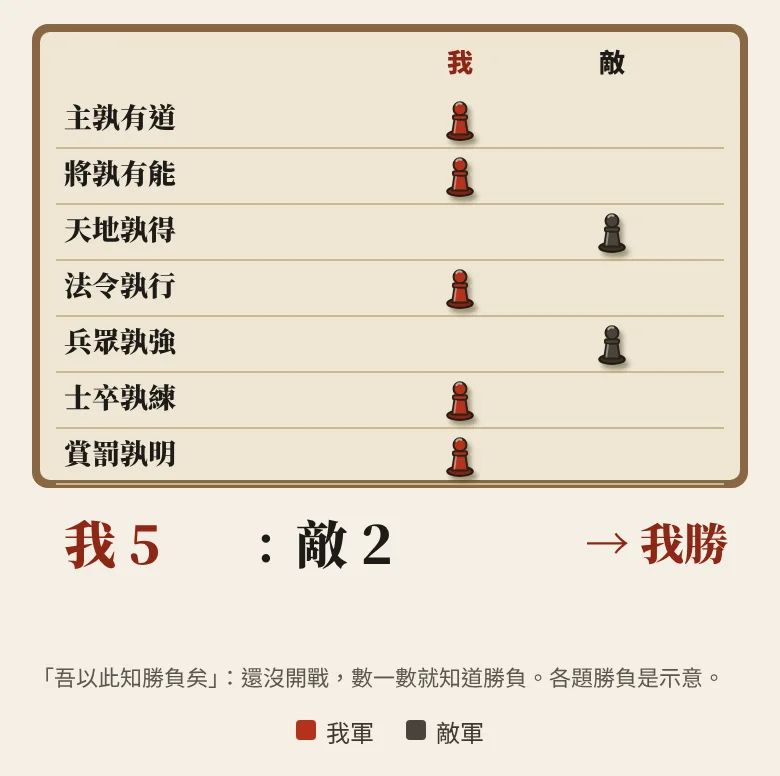
原故校之以七計而索其情,曰:主孰有道?將孰有能?天地孰得?法令孰行?兵眾孰強?士卒孰練?賞罰孰明?吾以此知勝負矣。〈始計〉
原意
即「七計」:誰的國君得人心、誰的將領有能力、誰占天時地利、誰的法令落實、誰兵力強、誰訓練精、誰賞罰分明,比一比就知道勝負。
延伸:用在今天
和競爭者逐項比較,比只看自己更能預判結果。
關鍵詞
- 道 dào shared purpose
案例 · 孫武練女兵
吳王闔閭以宮女試孫武練兵,宮女嬉笑不從,孫武斬了吳王兩位寵姬,此後號令嚴明。常用來說明「法令孰行」與「嚴」。
傳統故事(傳統故事,可信度存疑) · 出自《史記·孫子吳起列傳》;史家對其真實性有疑義,標為傳統故事
In English
Compare both sides with seven questions and the outcome becomes visible.
These are the seven comparisons: whose ruler has the people's trust, whose general is more able, who holds the advantages of weather and ground, whose rules are actually enforced, whose army is stronger, whose troops are better trained, and whose rewards and punishments are clearer. Set them side by side and the outcome becomes clear.
Applied today: Comparing yourself with a competitor point by point predicts results far better than looking only at yourself.
Original translation (Lionel Giles, 1910): Which of the two sovereigns is imbued with the Moral law? Which of the two generals has most ability? With whom lie the advantages derived from Heaven and Earth? On which side is discipline most rigorously enforced? Which army is stronger? On which side are officers and men more highly trained? In which army is there the greater constancy both in reward and punishment? By means of these seven considerations I can forecast victory or defeat.