〈軍爭〉第 11 課
從士氣、心理、體力和應變四方面壓制對手。
原故善用兵者,避其銳氣,擊其惰歸,此治氣者也;以治待亂,以靜待嘩,此治心者也;以近待遠,以佚待勞,以飽待饑,此治力者也;無邀正正之旗,無擊堂堂之陣,此治變者也。〈軍爭〉
原三軍可奪氣,將軍可奪心。〈軍爭〉
原是故朝氣銳,晝氣惰,暮氣歸。〈軍爭〉
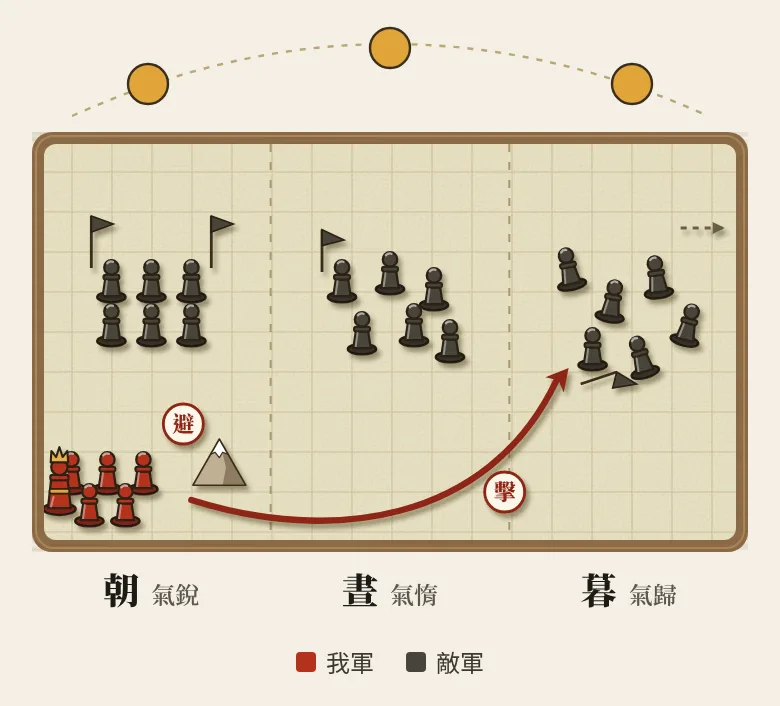
原意
敵軍的士氣可以挫敗,將領的決心可以動搖;士氣早上旺盛、中午懈怠、傍晚衰竭。善用兵的人避開敵人銳氣、在他懈怠時出擊,這是治氣;以嚴整對付混亂、以鎮靜對付喧嘩,這是治心;以近待遠、以逸待勞、以飽待飢,這是治力;不去攔截旗幟整齊的敵人、不去攻擊陣容堂堂的敵人,這是治變。
延伸:用在今天
談判或競爭時,選對時機,在對方疲憊、浮躁時出手。
關鍵詞
- 治氣治心治力治變 zhì qì zhì xīn zhì lì zhì biàn mastering spirit, mind, strength and change
案例 · 強弩之末:諸葛亮引兵法看曹軍
曹操追擊劉備,輕騎一日一夜跑了三百多里。諸葛亮在說服孫權聯合抗曹時指出,曹軍遠來疲憊,正是「強弩之末,勢不能穿魯縞」,並引兵法「必蹶上將軍」說明急行爭利的危險。不久曹軍在赤壁大敗。
史書有載 · 出自《三國志·蜀書·諸葛亮傳》
In English
Master spirit, mind, strength and change, and you master the opponent.
An army's spirit can be broken and a general's resolve shaken; spirit is keen in the morning, slack at midday and spent by evening. The skilled commander avoids the enemy's keen spirit and strikes when it is slack (mastering spirit); meets disorder with order and clamor with calm (mastering the mind); meets the far with the near, the tired with the rested, the hungry with the fed (mastering strength); and does not take on banners in perfect order or a formation in full array (mastering change).
Applied today: In a negotiation or a contest, choose your timing and act when the other side is tired or restless.
Original translation (Lionel Giles, 1910): A clever general, therefore, avoids an army when its spirit is keen, but attacks it when it is sluggish and inclined to return. This is the art of studying moods. Disciplined and calm, to await the appearance of disorder and hubbub amongst the enemy:—this is the art of retaining self-possession. To be near the goal while the enemy is still far from it, to wait at ease while the enemy is toiling and struggling, to be well-fed while the enemy is famished:—this is the art of husbanding one’s strength. To refrain from intercepting an enemy whose banners are in perfect order, to refrain from attacking an army drawn up in calm and confident array:—this is the art of studying circumstances.